Tree trimming is the regular upkeep that lets large trees and houses share a lot. Anderson Tree & Stump Co. handles tree trimming and pruning in Anderson and the towns around it, and quotes each job after seeing the trees.
Many Anderson neighborhoods were built among trees that are now fully grown. Their limbs reach roofs, driveways and service lines that were not there when the trees were young.
Helene also left a lot of unfinished business. Cracked limbs, broken tops and branches hung up in the canopy are still overhead in many yards, and trimming is how they are cleared.
A typical visit turns up a short list: one or two limbs to take off the roof, some dead wood, and maybe a crown that would do better with thinning.
You do not need to have that list ready. We look at the trees together, and you decide which items to do now and which to leave.
Call 864-581-2975 or send the form to ask for a free tree trimming quote.
Free quote. No obligation.
Branches are cut back from the house, the gutters, the chimney and parked cars. Growth close to a power line should be reported to your power company, and mentioned to us.
Dead, cracked and hanging limbs are taken out of the tree before they fall. After a storm this is often the main job.
A limb torn off by wind leaves a ragged stub and often a strip of peeled bark. The stub is cut back cleanly to the next sound branch so the tree can close the wound. A broken top is handled the same way, by cutting back to a side limb strong enough to take over.
Some inner branches are removed so that wind and light pass through. The outline of the tree stays the same.
The lowest branches are removed for headroom over a walk, a drive or the yard.
Early cuts set one strong central stem and well-spaced branches, which saves larger cuts later in the tree’s life.


If the large trees near the house have not been checked since Helene, now is a good time.
Looking up from the ground tells you a lot. Stand back far enough to see the whole crown. Look for limbs lying across other limbs, pale wood where bark has been stripped, and long cracks along the top of a heavy branch. Binoculars help with a tall tree. Anything that looks loose is worth pointing out on the visit.
Trees do not repair damaged wood. They grow over it. A clean cut at the branch collar gives the tree the best chance to cover the wound. A cut too close to the trunk, or one that leaves a long stub, stays open and can let decay start.
Restraint is part of it. Leaves are how a tree makes food, and removing too many at once weakens it. When a tree needs heavy work, doing it over two or three seasons is easier on the tree.
Species matter as well. Water oaks are prone to rot behind large cuts, so smaller cuts made more often suit them. Crape myrtles are better thinned than cut back to stubs every year.
There are things trimming cannot do. It will not save a tree with a rotten trunk, and it will not make a tree that is too large for its spot small again for long. In those cases the plain answer is better than a costly pruning job that only postpones the decision.
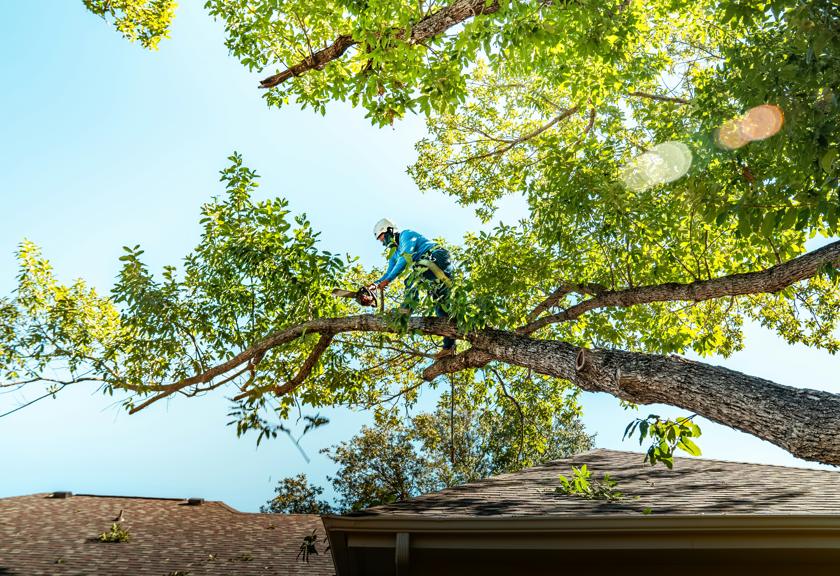
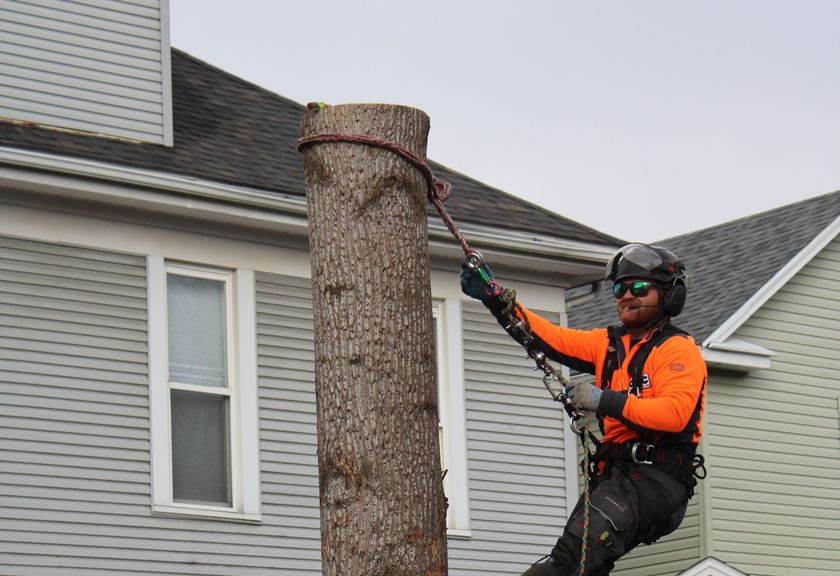
The cost of trimming follows the amount of climbing and cutting. Shaping a small ornamental tree is a minor job. Clearing limbs from a tall oak above a house, with ropes to lower each piece, is a larger one. Height, the volume of wood, what is beneath the tree and truck access all go into the quote.
Ask to have all your trees looked at together. If one is not worth trimming, we’ll say so, and tree removal can be quoted in its place.
There is no fixed schedule. A tree growing hard toward the house may need attention every couple of seasons. A mature oak in open ground can go much longer. Check the large trees near buildings once a year and after any major storm.
The dormant season, from late fall through winter, works for most trees. With the leaves off, problems are easier to see and the tree is under less stress. Broken or dead limbs should come out when you find them, whatever the month.
Topping is not recommended. Cutting the main stems back to stubs removes the leaves the tree lives on and leads to weak regrowth that breaks easily. To lower a tree, the crown is reduced gradually by cutting branches back to side limbs. If that won’t solve it, removal is the other choice.
Want a quote? Call 864-581-2975 or send the form. It’s free.
Start from the home page to see everything in one place, or go to the contact page to reach us.